
Alignment Without Authority—How Strategy Stops Governing Execution
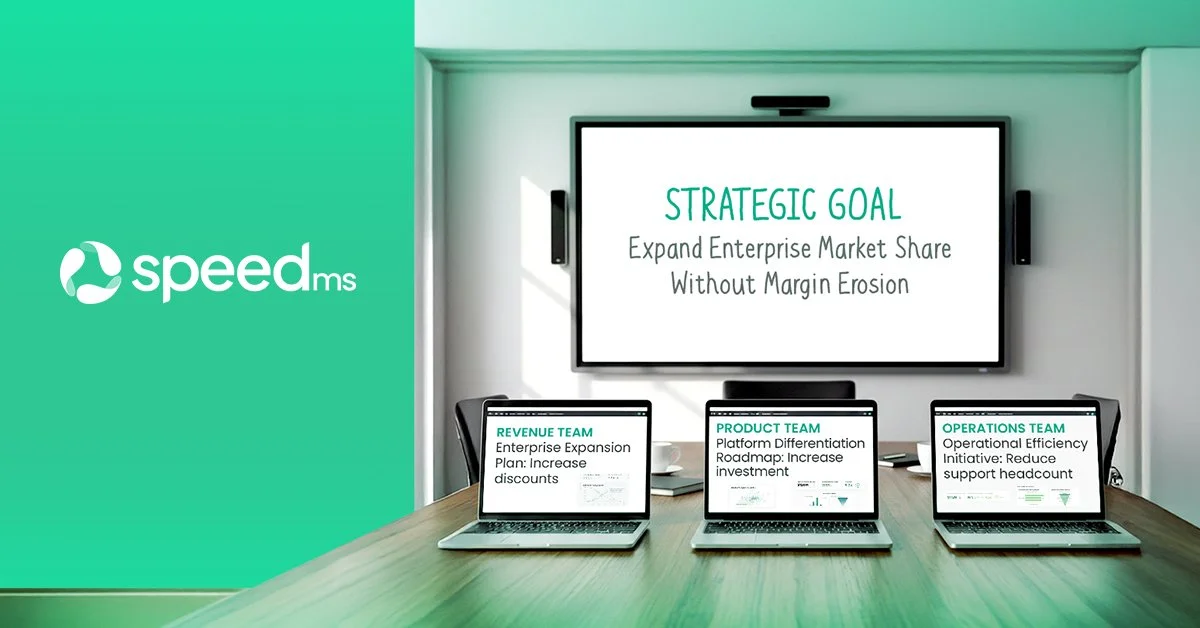
Most leadership teams don’t feel like they’re failing. They feel busy. Productive. Slightly underwater.
Strategy is discussed. Priorities are agreed upon. Meetings end with alignment. People work hard. And yet, over time, strategy stops governing what actually happens next. Decisions slow. Focus fragments. Accountability becomes harder to name without creating friction.
What’s happening isn’t a collapse. It’s something quieter — and far more common.
It’s the alignment breakdown.
Strategic drift sets in when a clear strategy loses authority over day-to-day decisions. Not because leaders stop caring, but because growth adds complexity faster than informal alignment can hold. The organization keeps moving — but no longer in a way that leadership can reliably govern.
That tension is why we built SPEEDms.
Not because companies lack ambition or talent. But because strategic drift is structural, and most leadership teams are left trying to manage it with tools that were never designed for the job.
Where This Started for Us
Joe’s view came from the inside. Years ago, Joe was part of the senior leadership team at a private-equity-backed company with a strong vision and capable leaders. The ambition was real. The effort was real. And yet, as the company grew, execution struggled to keep pace.
The strategy itself wasn’t wrong. But as the organization scaled, it became harder to translate that strategy into coordinated, sustained action — week after week, decision after decision.
From the board’s perspective, progress was difficult to see in real time. From inside the business, teams worked hard but often without shared clarity on priorities, tradeoffs, or how their work connected back to strategy. Reporting existed, but it lagged. Meetings multiplied. Work expanded.
Strategic drift had set in.
The same questions kept surfacing:
What are we actually trying to win?
What matters now versus later?
How do daily decisions connect to strategy?
How do we know if we’re making progress — or just staying busy?
The frustration wasn’t philosophical. It was practical. There was no shared system to keep strategy, execution, and accountability tightly connected as complexity increased.
Chris saw the same pattern — from the outside.
As a consultant and advisor, Chris worked with leadership teams who had solid strategies and plenty of project plans but were quietly drifting in execution. Leaders were exhausted trying to translate strategy upward to boards and downward to teams, while managing a constant flood of operational detail in between.
Different vantage points. Same diagnosis.
Strategic Drift Isn’t a People Problem
What we kept seeing wasn’t a lack of effort or intelligence.
It was a system gap.
Some tools sit too high. They document strategy, but don’t govern execution. Others sit too low. They manage tasks but can’t hold strategic tradeoffs.
Most mid-market organizations end up with both — and still lack a shared operating architecture that keeps strategy visible and decisions aligned once execution begins.
As complexity grows, this gap creates execution noise: more meetings, more dashboards, more updates — yet less clarity about what matters and what should change.
That’s how strategic drift takes hold. Quietly. Gradually. Expensively.
At some point, a simple realization became unavoidable:
Strategic drift isn’t inevitable — but it is predictable without the right system.
Why We Built SPEEDms Differently
From the beginning, we knew we weren’t just building software. We were trying to help leadership teams prevent — and correct — strategic drift.
That meant starting with the methodology, not the product.
We focused on designing a single, coherent flow that connects:
Strategy
Execution planning
Operating rhythm
Accountability
Evaluation
The goal wasn’t to add more process. It was to replace fragmentation with clarity, so strategy doesn’t fade as it moves into real work. Only after the methodology held together did the product make sense. Together, the methodology and the platform form a single system for governing execution.
And then reality refined it. Early customers taught us that even the right system fails if adoption feels heavy. So we redesigned implementation to remove friction without sacrificing rigor — clearer roles, faster onboarding, and a way to meet leadership teams exactly where they are.
Today, teams can bring whatever they have — strategy decks, KPIs, spreadsheets, operating rhythms — and within days, they’re operating inside a shared system that makes execution visible and drift harder to hide.
What SPEEDms Is Really For
SPEEDms exists to help leaders turn ambition into outcomes — by reducing strategic drift before it becomes costly.
Ambition without execution leads to frustration. Execution without strategic clarity leads to motion without progress.
We believe organizations matter — not just for performance, but for how people experience leadership, pressure, and trust. When strategy stays visible, accountability is shared, and reality is surfaced early, teams don’t just perform better. They operate with more confidence and less friction.
This work is personal for us. We’ve lived inside organizations where good people were trapped in unclear systems. SPEEDms exists to change that — not by controlling people, but by giving leaders and teams a shared way to see reality and course-correct together.
A Simple Invitation
If your organization feels busy but not decisive — active but not compounding — you may be experiencing strategic drift.
That’s what we built SPEEDms to solve.
If this resonates with what you’re seeing inside your own leadership rhythm, we’d welcome a conversation.
